Gold has long occupied a unique space in the global financial system, functioning simultaneously as a commodity, a currency, and a store of value. For decades, the orthodox framework for valuing gold has been rooted in the opportunity cost of holding non-yielding assets. According to this theory, the primary driver of gold’s price is the real interest rate—the nominal yield on safe-haven assets, such as U.S. Treasury bonds, minus the expected rate of inflation.
When real rates rise, the opportunity cost of holding gold increases, theoretically depressing its price. Conversely, when real rates fall or turn negative, gold becomes highly attractive. An examination of the 2016–2025 decade reveals that while this inverse relationship accurately dictated market dynamics for the first half of the period, a profound structural decoupling occurred between 2022 and 2025. Driven by geopolitical fragmentation and unprecedented central bank accumulation, gold has evolved from a purely rate-sensitive asset into a multi-dimensional macroeconomic hedge.
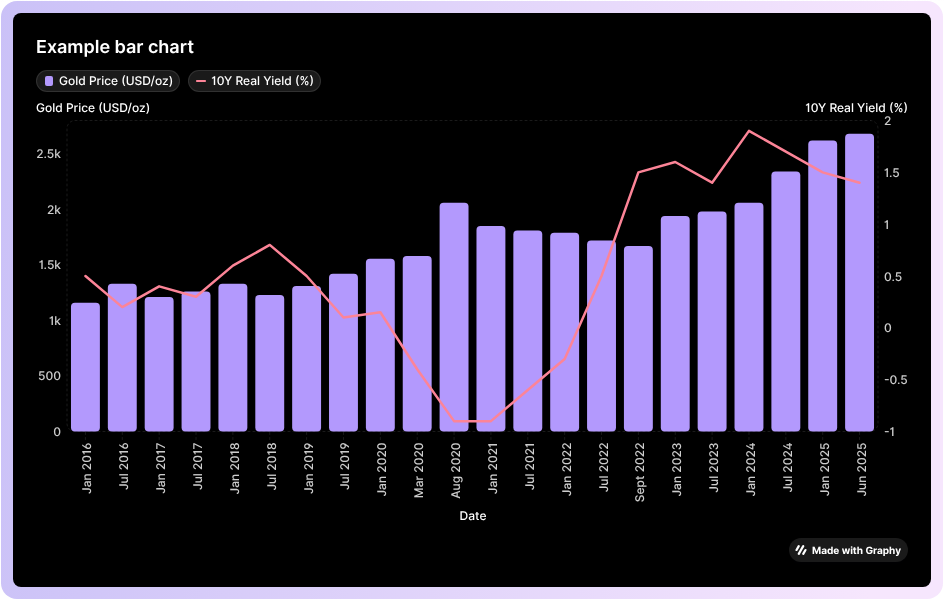
From 2016 to 2021, the traditional opportunity cost framework held firmly. During this period, statistical analysis demonstrates a strong negative correlation between gold prices and 10-year U.S. real yields. When the Federal Reserve engaged in gradual monetary tightening between 2017 and 2018, pushing real yields higher, gold prices stagnated or declined. However, the paradigm shifted dramatically during the 2020 global pandemic. As central banks slashed nominal rates to zero and initiated massive quantitative easing programs, real yields plunged into deeply negative territory, reaching approximately -0.9% by August 2020.
In perfect alignment with theoretical expectations, gold surged, breaching the $2,000 per ounce threshold for the first time in its history. During this five-year window, real yields explained nearly half of gold’s price variance, confirming its status as a highly sensitive barometer of monetary policy and real return expectations.
The integrity of this traditional relationship, however, fractured beginning in 2022. As global inflation surged, the Federal Reserve embarked on the most aggressive monetary tightening cycle in four decades. By late 2023, the 10-year real yield had skyrocketed from negative territory to nearly +1.9%, representing a massive swing of over 250 basis points.
Under the historical paradigm, this dramatic increase in the opportunity cost of holding non-yielding assets should have triggered a severe bear market in gold, driving prices well below $1,500. Instead, gold exhibited remarkable resilience, consolidating around $1,800 before breaking out to record nominal highs exceeding $2,600 by late 2024, and reaching $2,680 by mid-2025.
The correlation between gold returns and real yield changes plummeted from a strong -0.68 in the 2016–2021 period to a statistically insignificant -0.21 between 2022 and 2025. Real yields, once the dominant driver of gold’s valuation, were suddenly rendered largely irrelevant.
This decoupling can be attributed to the emergence of a massive geopolitical risk premium that overwhelmed traditional financial calculations. The outbreak of the Russia-Ukraine war in early 2022, followed by escalating tensions in the Middle East and ongoing U.S.-China strategic competition, fundamentally altered investor behavior.
In environments characterized by extreme systemic risk and potential supply chain disruptions, the preservation of capital supersedes the pursuit of yield. Consequently, gold’s traditional safe-haven properties were activated, allowing it to absorb the headwinds of rising real rates. Investors and institutions prioritized physical security and counterparty-risk mitigation over the marginal yield offered by Treasury bonds, effectively insulating gold from the opportunity cost effect.
Furthermore, the decoupling was heavily reinforced by a structural shift in global reserve management, specifically the unprecedented accumulation of gold by emerging market central banks. Following the unprecedented freezing of Russian central bank reserves by Western nations in 2022, the perceived risks of holding U.S. dollar-denominated assets increased significantly for non-allied nations.
In response, central banks—led by the People’s Bank of China, alongside Turkey, India, and Poland—initiated a historic buying spree. Between 2022 and 2024, global central banks purchased over 1,000 tonnes of gold annually, a volume not seen since the 1960s.
This demand is inherently price-inelastic and indifferent to Western interest rate dynamics. By creating a massive, structural price floor, central bank accumulation effectively decoupled gold from the traditional U.S. real yield matrix, transforming it into a vital instrument for de-dollarization and sovereign financial insulation.
In conclusion, the 2016–2025 decade represents a pivotal transition in the macroeconomic role of gold. While the first half of the period validated the traditional opportunity cost framework—demonstrating that gold remains highly sensitive to real interest rates in stable macroeconomic environments—the latter half exposed the limitations of this model.
The aggressive monetary tightening of 2022–2024 failed to suppress gold prices because the metal is no longer driven solely by the yield dynamics of the U.S. dollar system. Instead, gold has been re-priced to reflect a fragmented global order, where geopolitical instability and the strategic diversification of sovereign reserves act as dominant forces.
For investors, the lesson of the past decade is clear: while real interest rates remain a vital baseline for asset valuation, gold must now be analyzed through the lens of global geopolitics and the structural evolution of the international monetary system.