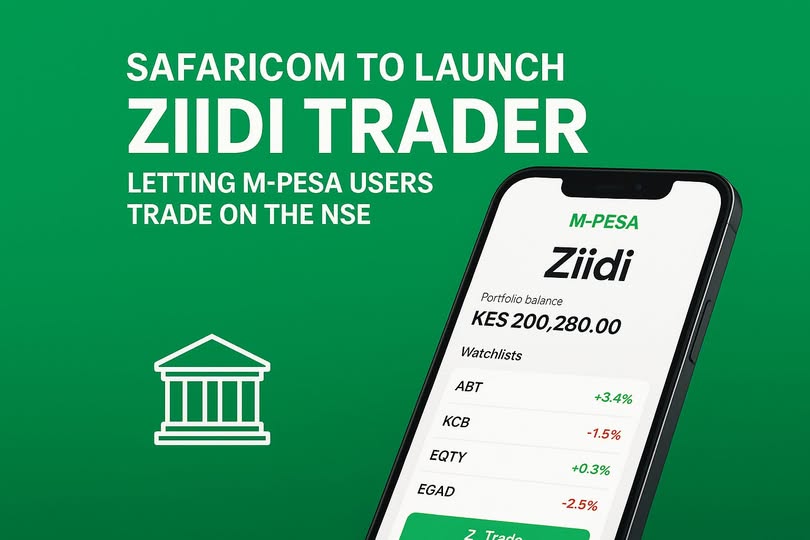
Safaricom’s rollout of Ziidi Trader, a stock trading platform embedded directly within M-Pesa, is more than a new feature. It represents a market-structure shift for the Nairobi Securities Exchange (NSE).
Before Ziidi Trader, Kenya had around 1.3–1.48 million registered investor accounts, but only about 61,000 were actively trading — roughly 4–5 % participation. Growth in active accounts between 2023 and 2025 was almost flat (~0.2%), highlighting that access barriers among other factors were limiting participation. The NSE had set an ambitious target of 9 million retail investors by 2029, showing significant room for expansion.
While these numbers suggest that access exists, active engagement is low due to multiple factors:
Why low active participation isn’t just about access
| Factor | Estimated Contribution to Low Activity |
|---|---|
| Platform friction | 30–40% |
| Economic / capital limits | 30–35% |
| Behavioral / literacy | 25–30% |
- Platform friction: Registration, funding accounts, and using older broker platforms were cumbersome for first-time investors. Ziidi Trader’s mobile integration removes much of this barrier.
- Economic / capital limits: Many registered investors lack disposable income to actively trade. Minimum trade sizes and fees can also be prohibitive.
- Behavioral / knowledge gaps: Fear of loss, limited financial literacy, and cultural perception of stocks reduce trading activity.
While Ziidi Trader removes much of the friction (~30–40%), the other ~60–70% of inactivity comes from capital constraints and behavioral/knowledge gaps. For the NSE to see meaningful participation growth, complementary strategies are needed, for instance , tools to build confidence (simulated trading, simple dashboards, clear disclosure) , Investor education campaigns and lower minimum trade sizes or micro-investing options.
For the first time, millions of Kenyans can now move from passive observers to active market participants using the same app they already trust for payments, savings, and everyday transactions. History is clear on one thing: when access barriers fall, markets do not behave the same way again.
What does the Ziidi Trader mean for retail investors, how is market behaviour on the NSE is likely to change, and where are both opportunities and risk most likely to emerge from ?
Why Ziidi Trader Is a Big Deal
For decades, access has been the NSE’s biggest constraint.
Opening a CDS account, choosing a broker, funding accounts, and navigating unfamiliar trading platforms created friction — practical and psychological. Ziidi Trader compresses that entire journey into something Kenyans already understand intuitively:
tap → confirm → transact.
That matters because markets are shaped less by spreadsheets and more by who can participate, how easily they can act, and how often they do so.
The pre-Ziidi statistics show why this matters: despite reforms like single-share trading, only a tiny fraction of the population actively invested. Less than 5 % of registered accounts traded regularly, and active participation growth was nearly stagnant. This context highlights the potential impact of simplifying access via Ziidi Trader.
What Changes When Trading Becomes Mass-Market
1. Participation explodes before sophistication does
When new retail investors enter through a low-friction platform like Ziidi Trader, they usually arrive with:
- Limited valuation frameworks
- Short time horizons
- High sensitivity to recent price moves
- Strong reliance on stories, WhatsApp tips, and social proof
The immediate impact is volume, not analysis. Prices begin to move faster than fundamentals.
2. Liquidity improves — but not evenly
Retail money does not spread itself efficiently across the market.
Early flows typically concentrate in:
- Familiar household names
- Highly visible large-cap stocks
- Counters with low nominal share prices that feel affordable
Because the NSE is relatively shallow, even modest inflows can push prices sharply higher — especially in illiquid names.
3. Price discovery becomes noisier
As Ziidi Trader expands participation:
- Valuation gaps widen
- Momentum temporarily overrides earnings
- Historically weak stocks get bought simply because “everything is going up”
Fundamentals do not disappear — they get delayed. Eventually, they reassert themselves.
Lessons from Other Markets
Global market history offers useful parallels:
- Mobile-first trading in India triggered sustained mid-cap reratings
- Commission-free apps in the US amplified speculative manias
- App-based access in emerging markets increased volatility while deepening capital markets
Kenya will not follow these paths exactly, but the direction of change is well established.
Likely Winners in a Ziidi Trader–Driven Market
Large, Familiar Growth Stocks
These stocks usually act as the entry point for first-time investors:
- Safaricom
- Tier-one banks
- Established consumer brands
They benefit from trust, recognisability, and the ability to absorb higher volumes without extreme volatility.
Quality Mid-Caps
As confidence builds, retail investors tend to move down the market-cap curve:
- Mid-tier banks
- Insurance companies
- Select industrial and infrastructure plays
This phase often produces the strongest valuation expansion.
Speculative and Turnaround Names
In later stages, sentiment spills over into:
- Loss-making firms
- Deeply discounted stocks
- “Former giants” anchored to old highs
This is where returns can look spectacular — and risks are highest.
What Ziidi Trader Means for Retail Investors
Greater access is empowering, but it also increases behavioural risk.
Retail investors using Ziidi Trader should be conscious that:
- Convenience encourages over-trading
- Rising prices can feel like confirmation of skill
- Volatility works in both directions
The objective should not be to trade more frequently, but to own better businesses more deliberately.
A Smarter Way to Navigate the Shift
Rather than chasing every move created by new liquidity:
- Focus on companies with durable earnings growth
- Understand why a stock is rising
- Be willing to hold cash during euphoric phases
- Use increased liquidity as an exit tool, not just an entry point
Structural change creates opportunity — but discipline determines who captures it.
The Bigger Picture
Ziidi Trader’s integration into M-Pesa is a milestone for Kenya’s capital markets. Over time, it can deepen liquidity, broaden ownership, and lower the cost of capital for listed companies.
In the short term, it will also introduce noise, mispricing, and emotion.
For investors who understand how markets behave when access widens, that is not a problem — it is the opportunity.