When Prices Stop Making Sense
Extreme surges in asset prices often reveal more about human behavior than economic fundamentals. Speculative bubbles arise when markets value assets not for their intrinsic utility or income, but for the belief that prices will continue rising. As optimism feeds on itself, prices detach from reality, leaving markets fragile and vulnerable to sudden collapses. While this pattern has existed for centuries, it continues to appear in modern markets, from Dot-com stocks to cryptocurrencies and complex derivative instruments.
History offers vivid examples. Seventeenth-century Tulip Mania in Holland showed how rarity, social status, and hype could drive prices far beyond intrinsic value. Centuries later, the Dot-com Bubble of the late 1990s reflected similar dynamics: companies with little or no profits saw stock prices soar based on future growth expectations, fueled by media coverage and investor FOMO. In the 21st century, cryptocurrencies and leveraged derivatives have again demonstrated how speculation, herd behavior, and social amplification can create dramatic price swings, often disconnected from tangible value.
Understanding these phenomena requires more than economic analysis. Legal and regulatory frameworks play a critical role in shaping market behavior. Lax oversight or unclear rules allow speculative excess to flourish, while post-collapse reforms aim to prevent repetition. Tulip Mania foreshadowed the challenges regulators face today: ensuring transparency, preventing manipulation, and protecting participants without stifling innovation. Modern derivatives markets, with their complex leverage, and decentralized crypto markets illustrate how quickly speculation can escalate when safeguards lag behind innovation.
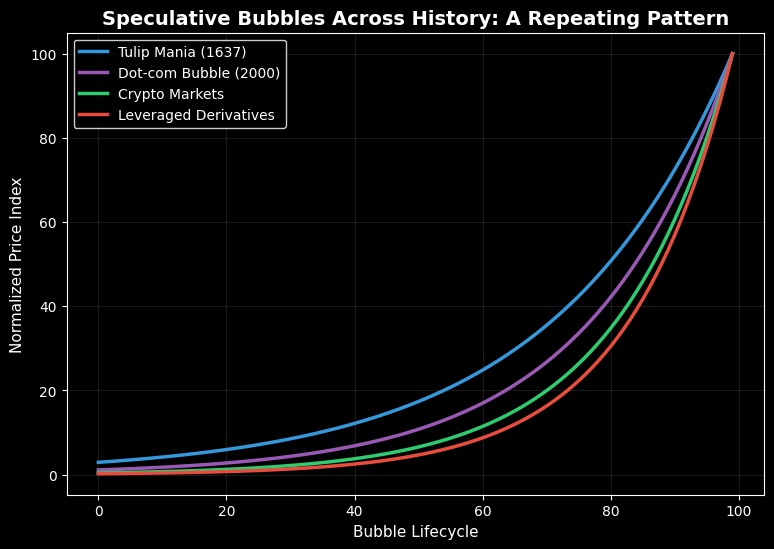
By examining speculative bubbles historically and in modern markets, recurring patterns become clear. Tulip Mania, the Dot-com Bubble, cryptocurrencies, and leveraged derivatives all reveal the same forces at work: exuberant psychology, herd behavior, and markets outpacing regulation. These lessons underscore the importance of understanding intrinsic value, practicing prudent risk management, and maintaining vigilant oversight. Whether in seventeenth-century Holland or today’s global high-tech markets, bubbles are a timeless reminder that human emotion can push prices far beyond reason, and while their forms evolve, their underlying mechanics remain strikingly consistent.
Tulip Mania: A Case Study in Speculative Excess
The Context: Prosperity and Novelty
In the early 1600s, the Dutch Republic experienced one of the first widely recorded financial frenzies: Tulip Mania. Tulips, imported from the Ottoman Empire, were prized not just for their beauty, but as a symbol of wealth and social status. The craze intensified when a virus, later called “mosaic,” caused some tulip petals to display multicolored, striking patterns, creating extremely rare and desirable varieties. As demand for these bulbs surged, tulips became a speculative commodity, traded at prices far above their intrinsic value.
Traders and florists introduced futures contracts, agreeing to purchase bulbs months in advance. Prices escalated rapidly: common varieties like the “Gouda” sold for wages equivalent to a week’s pay, while the rare Semper Augustus could cost what would amount to hundreds of thousands of dollars today. Eventually, the market became unsustainable. Early investors began cashing out, prices plateaued, and panic spread, culminating in a dramatic collapse—a textbook example of early market speculation and what we now call a “pump-and-dump.”
Centuries later, similar patterns have repeated. The Dot-com Bubble of the late 1990s saw investors pour money into internet startups with little or no profits, inflating valuations to extraordinary levels. When confidence faltered, the bubble burst, wiping out trillions in market value. More recently, cryptocurrencies and leveraged derivatives have exhibited comparable dynamics.
Across eras, speculation thrives when optimism, imitation, and the fear of missing out override rational analysis. Each bubble follows a familiar arc: prices surge on hype, early investors take profits, and eventually, a tipping point triggers panic and collapse. The lessons are timeless: without careful attention to fundamentals and risk management, markets—whether for tulips or Bitcoin—remain vulnerable to dramatic booms and busts.
The Lifecycle of a Bubble
Most speculative bubbles follow a recognizable pattern:
- Displacement: The Birth of a Narrative
A new or rare opportunity emerges—often tied to innovation, scarcity, or structural change. This generates excitement and a belief that traditional valuation no longer applies. - Boom: Rising Prices and Participation
Early adopters profit, attracting more attention. Media coverage amplifies interest, more investors enter, and prices rise steadily. Fundamentals are still relevant but are increasingly stretched. - Euphoria: Hype Dominates Value
Prices accelerate rapidly. Assets are bought not for their utility or income, but because buyers expect to sell at higher prices. Leverage grows, skepticism fades, and fear of missing out (FOMO) dominates. - Profit-Taking: The Turning Point
Smart money exits quietly. Volatility rises, gains slow, and confidence becomes fragile. - Panic and Collapse
A minor trigger can shatter confidence. Selling accelerates, liquidity dries up, and prices plummet, often overshooting below intrinsic value.
The Collapse: When Belief Failed
In early 1637, a routine tulip auction failed to attract buyers. Confidence evaporated almost instantly. Buyers refused to honor contracts, and prices fell by over 90 percent in some cases. The trigger itself was minor; the real issue was the sudden disappearance of belief. Tulips reverted to what they always were: flowers.
A central legal challenge at the time involved the enforceability of futures contracts. Buyers had agreed to purchase bulbs at a set price for future delivery. When the market collapsed, many refused to honor agreements, prompting a flood of disputes in Dutch courts. Judges often refused enforcement, viewing the contracts as speculative gambling rather than legitimate commerce.
The government eventually intervened, allowing contracts to be voided for a small fee, but the action came too late to prevent widespread losses. Tulip Mania highlights the difficulty of regulating speculative markets without clear legal frameworks.
Intrinsic Value vs. Market Hype
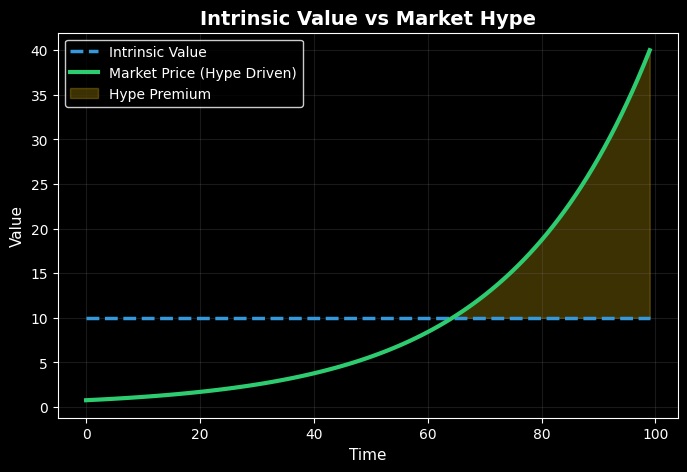
Tulip Mania underscores a fundamental investing principle: Price is what you pay; value is what you get.
- Intrinsic value is based on fundamentals—utility, income, or long-term relevance.
- Market hype is driven by:
- Compelling stories
- Social validation
- Rising prices themselves
When assets are priced purely on the expectation of future buyers rather than underlying value, bubbles form.
Why Tulip Mania Still Matters
Tulip Mania parallels modern speculative episodes:
- Dot-com stocks in the late 1990s
- Housing markets before 2008
- Cryptocurrencies and meme stocks in recent years
The assets change, but human psychology remains constant.
Key Lessons for Investors
- Scarcity does not guarantee value
- Rising prices are not proof of strong fundamentals
- When speculation becomes universal, risk peaks
- Bubbles burst when confidence collapses—not when logic intervenes
Conclusion: A Timeless Pattern
Tulip Mania was not a historical anomaly—it was a template. Markets will continue to produce bubbles as long as humans chase easy profits and compelling narratives. Understanding the difference between intrinsic value and market hype is one of the most powerful tools an investor can have.
History may not repeat itself exactly, but in financial markets, it often rhymes.