Financial markets have always been shaped by human behavior. Fear, greed, imitation, and overconfidence are not new forces. What is new is the speed, scale, and coordination with which these behaviors now spread—largely driven by online communities. From GameStop to meme coins, and from sudden sector manias to abrupt crashes, online platforms have become powerful amplifiers of market extremes. Understanding how this happens is no longer optional for investors—it is essential.
Market Disruptions in the Digital Age
In recent years, these markets have been shaken by events that defy traditional expectations and challenge conventional regulatory frameworks. Among the most striking of these was the GameStop short squeeze in early 2021, an episode that captured global attention and demonstrated the unprecedented power of retail investors. What began as a coordinated effort by online communities quickly escalated into a dramatic surge in GameStop’s stock price, disrupting established trading patterns and forcing institutional investors to react under intense market pressure.
The event highlighted a fundamental shift in market dynamics: information and influence no longer flow solely from professional analysts and large institutions. Social media platforms and online forums have become powerful tools that can mobilize thousands of individual investors, creating collective action capable of moving markets in ways previously thought impossible. Beyond the dramatic price swings, the GameStop saga revealed how narratives, group psychology, and digital connectivity can override traditional measures of value, forcing both market participants and regulators to reconsider the role of retail investors in shaping market outcomes.
Understanding Short Squeezes
Short selling is an investment technique used by traders who expect a stock’s price to decline. The strategy involves borrowing shares from a broker and selling them on the market at the current price, with the intention of buying them back later at a lower price to return to the lender. The trader profits from the difference between the initial sale price and the repurchase price. However, short selling is inherently risky, because if the stock price rises instead of falls, losses can be substantial—and theoretically unlimited.
Short squeezes occur when investors who have borrowed and sold shares are forced to repurchase them quickly as prices rise, often triggering cascading buying pressures. GameStop presented a particularly vulnerable situation: short positions exceeded the total number of available shares, a scenario sometimes referred to as “naked shorting.” This extraordinary concentration of short interest created the perfect storm for a massive price surge.
The role of online communities in amplifying this event was pivotal. Platforms like Reddit enabled participants to share information, strategies, and encouragement in real time, fostering a sense of collective purpose that traditional channels could not replicate. Research by Kim, Lee, and Kauffman (2023) shows that posts on Reddit were strongly correlated with GameStop trading volumes during the squeeze, highlighting how digital communication can directly influence market behavior. In today’s interconnected markets, social dynamics can be as powerful as fundamentals in shaping outcomes.
GameStop Before the Squeeze
Before the 2021 frenzy, GameStop was primarily a brick-and-mortar video game retailer in the United States, with a modest online presence. Its core operations included:
- Physical Retail Stores: Over 5,000 stores worldwide, selling new and pre-owned video games, consoles, and accessories. Pre-owned games were highly profitable.
- New Game and Hardware Sales: GameStop sold the latest titles for PlayStation, Xbox, and Nintendo Switch, plus consoles and accessories.
- Digital Services & e-Commerce (Limited): The online store and digital offerings were small compared to Amazon and direct-to-consumer platforms.
- Loyalty Programs: The PowerUp Rewards program encouraged repeat business and tracked pre-owned game sales.
Challenges Before the Squeeze
- Declining Physical Retail: The market was moving toward digital downloads, making GameStop’s store-heavy model vulnerable.
- Competition from E-Commerce: Amazon, Walmart, and console makers offered convenient alternatives.
- Thin Margins on New Games: Reliance on pre-owned games for profitability.
- Lag in Digital Transition: GameStop was slow to pivot to online-only sales and subscriptions.
Hedge funds and institutional investors saw these factors as signs of a struggling business, motivating heavy short selling, believing the company was overvalued. At one point, short interest exceeded 138% of available shares, creating a highly vulnerable scenario if prices were to go up.
How Retail Investors Coordinated
Individual traders, armed with small amounts of capital but a lot of collective influence, began noticing the unusually high short interest in GameStop. Using platforms like Reddit, Twitter, and Discord, they:
- Shared research and bullish sentiment,
- Coordinated buying strategies, and
- Built momentum that attracted even more participants.
Suddenly, a stock that many institutions expected to fall was being driven upward by thousands of individual traders acting together. As demand rose, institutional short sellers faced mounting losses and were forced to buy back shares, fueling a feedback loop that drove the stock even higher.
Timeline of the GameStop Surge
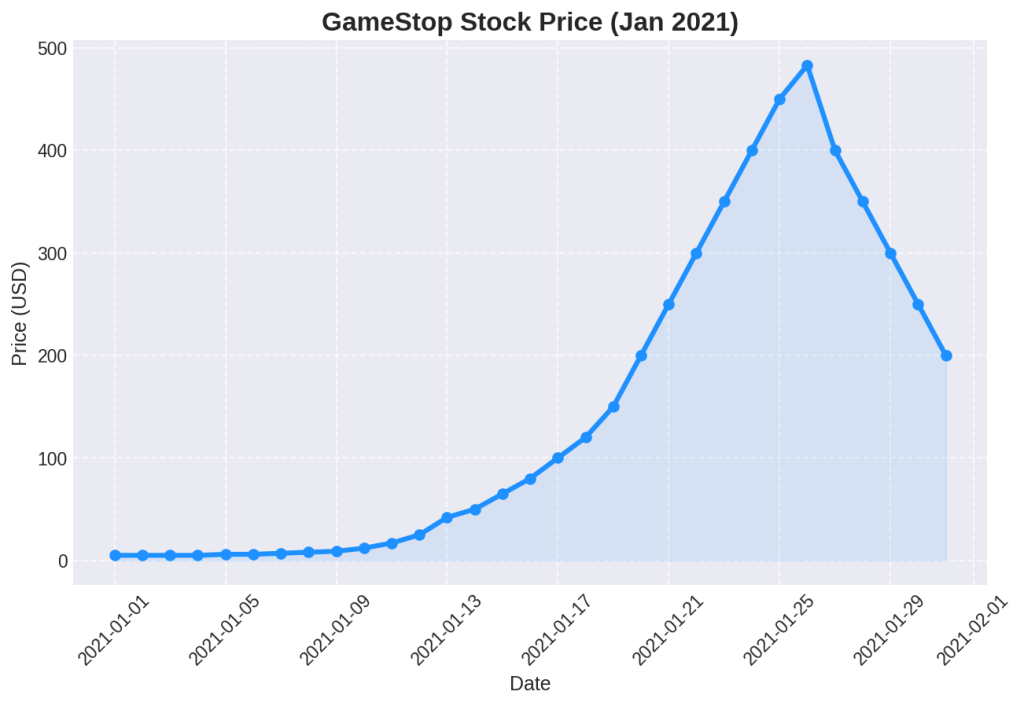
- Late 2020: GameStop traded around $4–5 per share, seen as a struggling retailer.
- January 11, 2021: Interest surged after Ryan Cohen joined the board; GME climbed above $17.
- January 22–25: The stock jumped from $42 to over $150, fueled by social media excitement.
- January 27–28: GME reached its peak, hitting nearly $483 per share in intraday trading.
During this period, trading halts and volatility warnings became common, but the momentum kept growing as retail investors continued their coordinated push.
Retail and Institutional Interaction
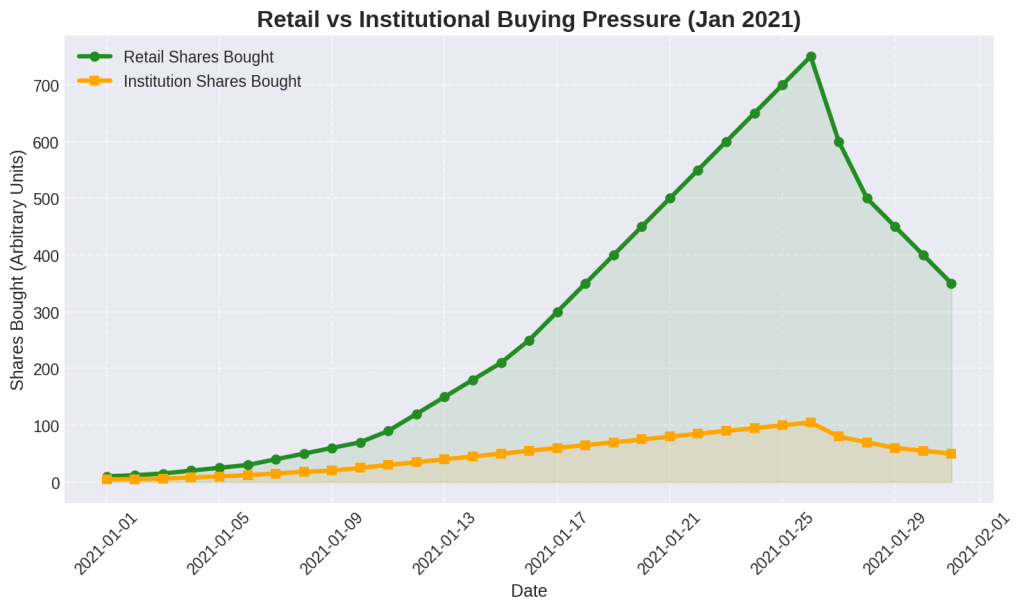
The short squeeze unfolded in three key steps:
- Retail buying pressure: Thousands of individual investors bought shares, steadily increasing demand.
- Institutional short covering: Hedge funds holding short positions were forced to buy back shares to limit losses, adding even more upward pressure.
- Price feedback loop: Each forced purchase pushed the stock higher, triggering further margin calls and more buying.
This combination of collective retail action and forced institutional responses is what made the GameStop squeeze so extreme.
The Decline and Aftermath
No bubble lasts forever. After peaking near $483, the frenzy subsided. Trading cooled, speculative interest waned, and the stock price fell sharply back to more moderate levels in the following weeks. Yet, the GameStop saga left a lasting mark on how investors view retail coordination and market influence.
The short squeeze caused billions of dollars in losses for hedge funds that had bet against GME:
- Melvin Capital reportedly lost over $6 billion and required a capital injection from other hedge funds.
- Other hedge funds also faced multi-billion-dollar losses.
- Total estimated losses from the short squeeze across all institutions: $10–20 billion.
Retail traders also faced high risks:
- Timing was critical: Buying near the $483 peak led to losses of over 80% when prices fell to $80–$100.
- Volatility wiped out gains quickly: Rapid intraday swings caused substantial losses.
- Margin trading amplified losses: Leveraged trades magnified both gains and losses.
- Psychological impact: FOMO (Fear Of Missing Out) drove late buyers into unsustainable prices.
Key Lessons from GameStop
- Retail investors have real power: Coordinated action can move markets in ways previously thought impossible.
- Short positions carry extreme risk: Betting against heavily shorted stocks can lead to massive losses.
- Social media can amplify trends: Platforms like Reddit and Twitter can influence real-world trading.
- Volatility is amplified by coordination: Short squeezes feed on themselves, creating rapid price swings.
The GameStop short squeeze wasn’t just a market anomaly—it was a wake-up call. In today’s digital age, ordinary traders, connected online, can challenge Wall Street and disrupt traditional expectations. It demonstrated a new era of retail investor influence, where social coordination can outweigh traditional valuations and financial models.
Retail investors, empowered by technology and social networks, can now mobilize rapidly to influence prices and disrupt conventional expectations. For policymakers, market participants, and researchers, this event underscores the importance of considering both behavioral and technological factors in understanding market behavior. The traditional assumptions of market efficiency may no longer fully capture the realities of a digital, networked trading environment.